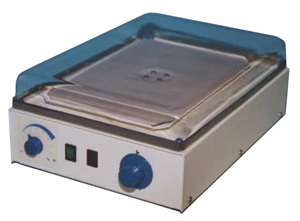

ROTATOR, orbital, for agglutination test, 230 V

STD
ELAEROTE2--
Valid Article
Account code:
60110
HS Code:
901890
Last Updated on:
20/01/2026, 22:02:07
Former
Code(s):
-X ELAEROTA2--

W020790 - Various general purpose ivd instruments
European Medical Device Nomenclature (EMDN) is the nomenclature of use by manufacturers when registering their medical devices in the EUDAMED database. EMDN is characterised by its alphanumeric structure that is established in a seven-level hierarchical tree.

 OC subscriptions: included in supply or field order tools (e.g. UniField)
|
|
 SC subscriptions: included in supply or field tools
|
|
 OC validations: approved for procurement and use by an OC for international or local orders specifying context and activity in Medical Standard Lists (MSL)
|
|
ROTATOR, orbital
Definition
An orbital rotator for agglutination tests is a laboratory device designed to provide controlled, gentle orbital motion to slides or cards used in agglutination assays, ensuring uniform mixing of reagents while preserving the integrity of agglutinates.
Specifications
- Power supply: 230 V
- Amplitude: ± 50 mm
- Adjustable speed from 40 to 120 rpm (alternatively 100 rpm fixed speed)
- Timer: 0-15 min
- Plastic cover (essential to protect the reagents on the test cards/slides from dust or evaporation)
- Plate/platform for agglutination cards on the rotator (ideally anti-slip)
Technical specifications
Speed requirements for MSF standard tests:
- SSDTBRUC50T Rose Bengal for Brucellosis : 80-100rpm
- SSDTMENT25T Pastorex for Meningitis : 120rpm
- SSDTSYPT100T RPR for Syphilis : 100±5 rpm
Instructions for use
Place the rotator on a level surface.
To prevent the plates to dry up during the rotation, place an absorbent paper soaked with water under the cover before closing.
Storage
Protected from humidity, heat and dust.
MSF requirements
Basic model intended for use in agglutination tests such as RPR for Syphilis, Pastorex for Menigitis and Rose Bengal for Brucellosis
For the CATT test (trypanosomiasis), prefer the rotator ITMAS.
Some restricted information has been hidden. Sign in
to see this information
![[SSDTBRUC50T] TEST BRUCELLOSIS, Rose Bengal, ser, 1t (Spinreact 1200901)](/web/image/product.template/588507/image_256/%5BSSDTBRUC50T%5D%20TEST%20BRUCELLOSIS%2C%20Rose%20Bengal%2C%20ser%2C%201t%20%28Spinreact%201200901%29?unique=a45dc8d)
![[SSDTMENT25T] MENINGITIS A, B, C, Y/W135 TEST (Pastorex), CSF,1 test 61607](/web/image/product.template/569165/image_256/%5BSSDTMENT25T%5D%20MENINGITIS%20A%2C%20B%2C%20C%2C%20Y-W135%20TEST%20%28Pastorex%29%2C%20CSF%2C1%20test%2061607?unique=d742a7e)
![[SSDTSYPT25T] SYPHILIS RPR TEST, carbon test, ser/pl, 1test (ARL. 900025)](/web/image/product.template/568861/image_256/%5BSSDTSYPT25T%5D%20SYPHILIS%20RPR%20TEST%2C%20carbon%20test%2C%20ser-pl%2C%201test%20%28ARL.%20900025%29?unique=fa61836)